-
NEWS
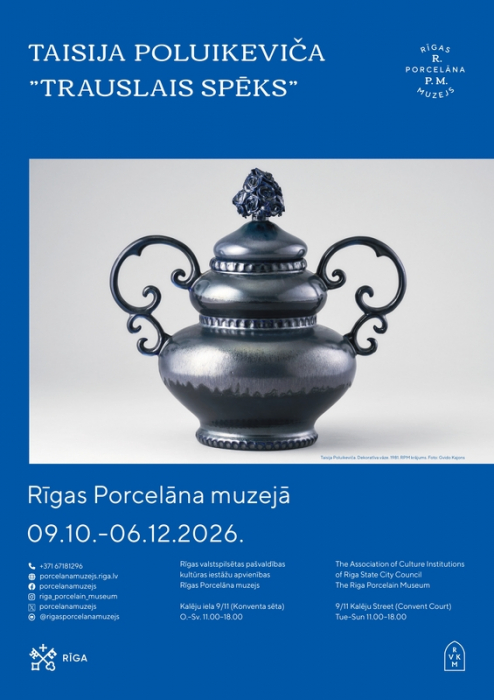
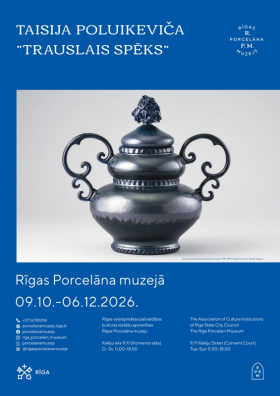 Exhibition “Taisija Poluikeviča. The Delicate Strength”
From 9 October to 6 December 2026, the Riga Porcelain Museum presents the exhibition “Taisija Poluikeviča. The Delicate Strength.”
The exhibition is a tribute to Taisija Poluikeviča, her multifaceted creative career, her contribution to the design of products manufactured at the Riga Porcelain Factory, and her work in researching the history of Riga porcelain.
Taisija Poluikeviča (1937–2002) was one of the leading designers at the Riga Porcelain Factory, specialising in the development of forms and creating original designs and decorative painting. Alongside her work as a designer, she was an art historian and publicist and headed the Riga Porcelain Factory Museum. Together with Zigurds Konstants, she co-authored Riga Porcelain and Faience (1984), which remains the most comprehensive study of the history of porcelain produced in Riga.
The exhibition features numerous once-popular and still recognisable tableware designs created by the artist, including “Marijka,” “Vasara,” “Anita,” “Ija,” “Vakars,” “Karīna” and “Spīdola,” as well as a wide variety of tableware sets, individual objects and souvenirs produced from the early 1960s to the late 1980s.
In her designs for mass production, Poluikeviča successfully combined functionality and artistic expression. Her forms were simplified and practical, well suited to manufacturing technologies and everyday use, yet they retained her distinctive artistic signature. The most visually striking part of the exhibition comprises the artist’s original works, which most vividly reveal her creativity. In her tableware sets, plates and vases, sculptural forms are combined with openwork details, the use of lustre, gold and cobalt, and virtuoso decorative painting.
Taisija Poluikeviča received her artistic education at the Ceramics Department of the Riga Secondary School of Applied Arts, graduating in 1957. Her classmates included several artists who later became renowned ceramicists: Valdis de Būrs, Izabella Krolle, Violeta Jātniece, Skaidrīte Cihovska, Maiga Dimza-Dimme and Kaiva Elliņa. In 1957, Poluikeviča began working as a sculptor at the Riga Porcelain and Faience Factory. In 1960, she was transferred to the factory’s artistic laboratory, marking the beginning of her independent creative career.
In 1963, she enrolled in the correspondence programme in art history at the Latvian Academy of Art, then known as the State Academy of Art of the Latvian SSR. Her diploma thesis, completed in 1969, laid the foundations for the interpretation of the history of porcelain and faience in Latvia. Throughout the 1970s and 1980s, she wrote extensively about the history of Riga porcelain, contemporary manufacturing and creative processes, and the artists involved. In the early 1970s, Poluikeviča became head of the Riga Porcelain Factory Museum. In 1988, illness forced her to end her work at the Riga Porcelain Factory.
Taisija Poluikeviča’s works are held in the collections of the Riga Porcelain Museum, the Museum of the History of Riga and Navigation, the Decorative Arts and Design Museum of the Latvian National Museum of Art, Zuzeum Art Museum and private collections.