-
NEWS
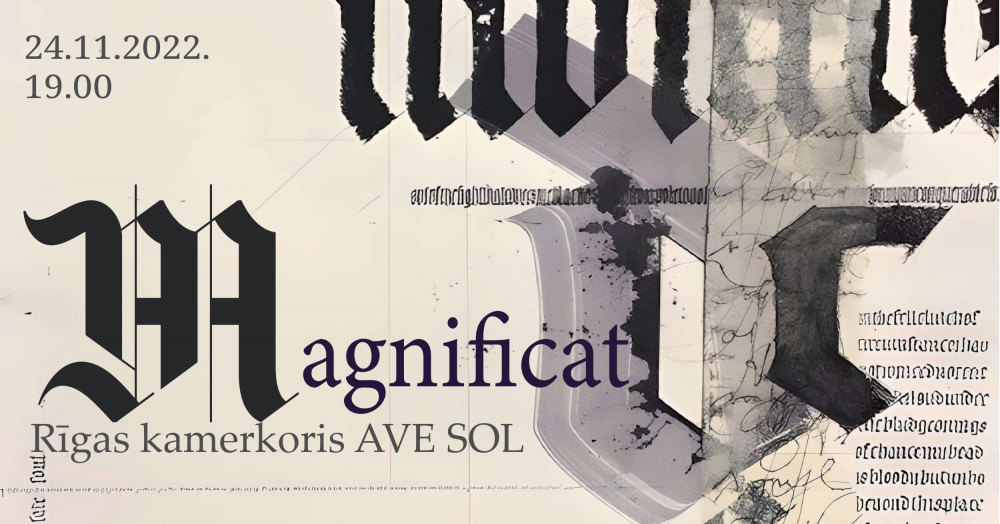
 The latest concert program MAGNIFICAT of the Riga Chamber Choir "Ave Sol".
On November 24, 2022 at 19.00 Riga Chamber Choir "Ave Sol" and its artistic director Andris Veismanis invites you to the latest concert program "Magnificat", where Ukrainian baroque music by outstanding choral composers not yet heard in Latvia will be played.
On November 24, 2022 at 19.00 in the premises of the Riga History and Shipping Museum, concertgoers are invited to find answers to two questions - how does war affect music and how does music affect war?
The "Magnificat" concert program covers and traces through the ages various depictions of war themes in music. In Jāzeps Vītols' chrestomatic ballad with Auseklis' words "Beverīnas dziedonis" and in Jēkabs Jančevskis work "O lux beata", both compositions deal with the Battle of Beverīna in 1208. J. Vītols examines Beverīna in the national romantic verses of Auseklis, whereas J. Jančevskis has chosen a text in Latin, the musical expression of which resembles the reproduction of medieval chants in Karl Orff's legendary cantata "Carmina Burana" (1935). Jančevskis work, full of drama, lyricism and constant unexpected affective contrasts, is definitely a step towards a deeper understanding of the depicted theme, both content-wise and spiritually.
When it comes to the topic "how war affects music", one does not have to look far for the clear artistic vision of conductor Andris Veismanis. His student, master's student Sergiy Zadorozhny, brought three sacred Ukrainian baroque concerts from Ukraine to Riga - extremely bright and magnificent works by an anonymous author, which, if they were not in ancient Ukrainian, would be difficult to distinguish from the works of the greatest Western European composers.
After the Thirty Years' War, which affected a large part of the life of the German baroque composer Heinrich Schitz, a year before his death, H. Schitz composed his swan song - "Deutsches Magnificat", in which, despite the great age of the composer, youthful musical tendencies can be felt. During the war, he composed mostly smaller works (the concert program from this time includes "In te Domine speravi").
In the concert program through G. P. da Palestrina’ five motets will examine the "war for love" - desires, desires from the Old Testament series of love poems by Solomon, "High Songs", also known as the "Song of Songs".
During World War II, the French composer Olivier Messiaen created a masterpiece of chamber music in a war prisoner camp, the instrumental composition of which was determined by the available musicians from among fellow prisoners - "Quatuor pour la fin du temps". Its fifth movement, "Louange à l'Éternité de Jésus", whose tempo is "infinitely slow", will be performed in the arrangement by Clytus Gottwald for a nineteen-part mixed choir.
At the end of the concert, listeners will hear "a ray of light beyond the war", as a warm memory of days gone by and at the same time a wish and praise for peace - Edward Elgar's "Lux aeterna" ("Eternal Light"), or the ninth variation "Nimrod" from the variation cycle "Enigma Variations" by John Cameron's arrangement for mixed a cappella choir.
Over time, the Riga Chamber Choir "Ave Sol" has become an integral part of the cultural heritage of Riga and Latvia. Successes have been achieved by participating in international competitions, as well as by making music with world-famous conductors and orchestras. Even today, the Riga Chamber Choir "Ave Sol" continues to look for new musical challenges and participates in bold projects based on the synthesis of various artistic genres, while also not forgetting to promote the values of classical Latvian and world choral music.
Concert program: Heinrich Schitz, Giovanni Pierluigi da Palestrina, Jēkabs Jančevskis
Edward Elgar, Olivier Messiaen, Ukrainian Baroque music.
Tickets available at "Biļešu paradīze" box office and www.bilesuparadize.lv