-
NEWS
 The exhibition “Māris Ārgalis. Milky Way” at Riga Art Space
From 19 March to 19 April Riga Art Space is hosting an exhibition "Māris Ārgalis. Milky Way"
"Emotional prediction is no less important than scientific [prediction], and here the fine arts have a particular role and debt to the society. Having liberated themselves from the centuries` of subordination to language, i.e. literature, the fine arts are being impregnated with the methodology of science, creatively discovering and reassessing ever deeper layers of their historical structure and human consciousness, and releasing reserves of emotionality."
Māris Ārgalis, 1977
Māris Ārgalis (04.03.1954–28.06.2008) is one of the most idiosyncratic personalities in the history of Latvian art, whose broad and eclectic creative legacy has so far been analysed only fragmentarily. This is primarily attributable to the rare exhibiting of his works in group shows and the fact that only one solo show of his works was held during his lifetime (in Riga and Cēsis).
Māris Ārgalis was born on March 4, 1954 in Riga. In 1972, he graduated from Janis Rozentāls’ Art High School. Thereafter, he continued his studies in the Sculpture Department of the Art Academy of Latvia, which he left in 1974 without graduating from the Academy. Māris Ārgalis took part in exhibitions from 1973 onwards, including a group exhibition organized together with his fellow students in the Hall of the Art Academy of Latvia. This exhibition was closed an hour after its opening, because somebody had espied some traits of surrealism in Māris Ārgalis’ works. Even before that Māris Ārgalis was known for his rebellious behaviour; however, the management of Rozentāls’ Art High School had tolerated it, brushing over his behavioural shortcomings on account of his outstanding drawing skills.
After quitting his studies, Māris Ārgalis continued to make art, mainly by doing commissioned jobs – painting interiors, drawing press illustrations, making posters and record sleeve designs. However, art history associates his name primarily with graphics, to which Māris Ārgalis turned his attention in the mid-70s thanks to the opening of the lithography studio at the Artists’ Union House. It was at this particular time that print reached its zenith in Latvian art. The etching and lithography studios were located in the Artists’ Union House which was subordinated to the Art Foundation, and it was the Foundation that provided the technical base and commissioned and sold works of art – the Foundation paid wages to experts, signed contracts with designers and bought work. Logically, there was no shortage of enthusiasts for lithography. During this period Latvian art experienced a rise in popularity of surrealism, whose key figures were Māris Ārgalis, the expressionist Arturs Ņikitins, the creatively eclectic Semjon Segelman and Ilmārs Blumbergs with his serial works.
In 1978, Māris Ārgalis organized his first and to date the only solo show "Models" in Riga at the Exhibition Hall of LSSR Science House or the Planetarium (the Orthodox Cathedral, Brīvības Bulvāris 23), where he exhibited his graphic works and various environmental objects, which had been inspired by the ideas of kinetic art and constructivism. These interests manifested themselves in his creative output through his activity in the so-called Emissionists’ group. The origins of the group were connected to the interest of its members in the legacy of the artist Gustavs Klucis. The members of the group were Māris Ārgalis, Valdis Celms, Jānis Borgs, Kirils Šmeļkovs, and Māris Ārgalis’ spouse Anda Ārgale, an architect. The group’s activity was characterized by inter-disciplinary projects, in which the presence of architectonic graphic structures was combined with elements of design, kinetic and constructive dynamics. There is a marked interest in space in both Māris Ārgalis’ conceptual projects created under the auspices of the Emissionists’ group and his works made using traditional media. One example worth mentioning is the series of work entitled Owl Cubes or Toys for Adults, in which drawings of owls were transformed into large-scale cubes, which visitors of Māris Ārgalis’ solo show were permitted to move, creating their own exhibition layout. However, the Emissionists’ group broke up under the “shadow of paranoid and Kafkaesque conflicts with the powers-that-be”, receiving a one-year publicity ban for no clearly defined reason.
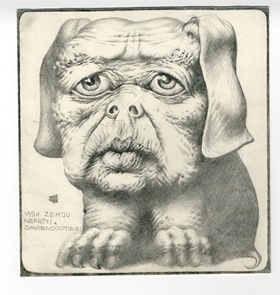
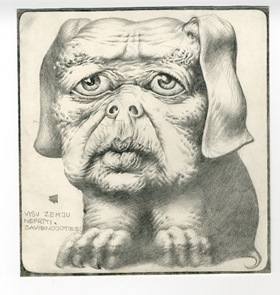
Unusual spatial structures are also a characteristic feature of Māris Ārgalis’ two-dimensional graphic and painting works, which are dominated by compositions and narratives inspired by surrealism. Although Māris Ārgalis took an interest in the works of the Western surrealists, he did not openly count himself among the followers of the movement. In his works, the traits of surrealism mostly reveal themselves through his aforementioned interest in the possibilities for depicting space, as well as in his unusual characters, which often combine human and animalistic features. Māris Ārgalis’ works are more precisely characterized by the concepts of multi-layering and association: linear rhythms, plasticity of forms and contrasts of light in his compositions are not only a formal means of expression, but also one of the main determinants of character and mood. Instead of realistically depicted forms and narrative simplicity, Māris Ārgalis opts for formal stylization and surreal transformation, accenting the associative meaning of his subject matter. A subjectively associative slant largely characterizes Latvia’s art scene in the 1970s, but Māris Ārgalis’ works stand out therein through the geometric depiction of peculiar forms and content, which is more intellectual than emotional.
During the 1970s, Māris Ārgalis took part in many group exhibitions not only in the LSSR, but also in the wider Soviet Union, as well as internationally, including, the Tallinn Graphics Triennial (1977), the pan-union art exhibitions in Moscow (1977), the exhibition of works by artists from Soviet Latvia in Sydney, Australia (1979), etc. However, after 1979, Māris Ārgalis ceased his public activity in art. This was largely due to the printing of the New Year Graphisms series. The New Year Graphisms were 12 New Year greeting cards drawn by Māris Ārgalis, which, with their outlandish imagery, differed from the sentimental greeting card design solutions typical of that era. Due to the large print run (500 screen printed copies of each work), the series attracted the attention of the State Security Committee, which erroneously perceived the drawings as encouraging a boycott of the Moscow Olympic Games and even terror, and also accused Māris Ārgalis of earning too much from these works. At this moment, Māris Ārgalis disappeared from the public art scene, continuing to work at his father’s home, where he established his own screen printing studio. This was the emotional harbinger for his first company "Vaga", which was legally founded in 1992.
Māris Ārgalis’ name gained publicity once more when he started working in the banking sector in the early 1990s. In 1995 and 1996, he was the vice-president of "Lainbanka" and president of the People’s Bank. When they went bankrupt, Māris Ārgalis was imprisoned for just under a year and held in an investigation cell together with criminals. After this public and personal humiliation, inwardly he was a broken man. The criminal case against him was never completed, no court hearing was held, and he never received a sentence or an apology.
However, on rare occasions during the 90s, Māris Ārgalis’ works would feature in individual group shows such as Geo Ģeo at Pedvāle; Personal Time. The Art of Estonia, Latvia and Lithuania from 1945-1996 in Warsaw and Saint Petersburg (all of which took place in1996). However, this participation in the overall process of Latvian art was no longer organized by himself; he was reduced to the status of an observer from a distance. In this period, Māris Ārgalis perceived the pinnacle of his art to be the "financial market psycho-technology project" to which he devoted the last years of his life. However, his desire to earn money without limit remained stuck on the drawing board. He was ultimately unable to decipher the operating principles of psycho-technological stock exchanges.
While being involved in banking, Māris Ārgalis had already construed ongoing events to constitute the highest manifestation of art – a happening whose bet was his life. Unable to switch to other realms of existence and recognizing the failure of his financial experiment; on June 28, 2008, Māris Ārgalis played out the last happening of his life, which was a pre-conceived suicide whose outcome was determined by chance. He died at the age of 54, leaving behind him an existential path worthy of the labyrinth of the Minotaur.
Curator: Ieva Kalniņa
Exhibition Layout Designers: Anda Ārgale, Jānis Ārgalis
Exhibition Graphic Designer: Kirils Šmeļkovs